Hamlet
Mariners' Museum, Uncurated Search Results
Type: Bugeye
Year: 1890
Builder: J. Branford
Location: Fishing Island

These records are found in the online catalog of The Mariners’ Museum and Park in Newport News, Virginia. Uncurated search results are presented to give researchers and interested readers an idea of whether the museum’s archives contain information about this vessel and whether it may be worthwhile to visit the museum’s catalog search page for further investigation. Uncurated results may be inaccurate or incomplete.
Search mode: Exact Name. Search phrase(s): "Hamlet". Results returned: 8. Results displayed in this table: 8.
Use these buttons to send uncurated search results to your own app or text document for further research. First, check the box for any row, or click "Select All" then uncheck any rows. Then click "Show Selections". You can then copy your selections from the text box and past them into your app.
| Fetch? | Row ID | Media | Date | Vessel | Place | Related Places | Inscription/Marks | Subject | Notes | Archive Number |
|---|---|---|---|---|---|---|---|---|---|---|
| 1 | 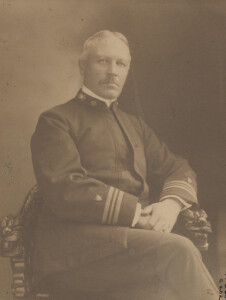 | 1905 | handwritten on verso: O.C. Hamlet, 1905- U.S. Revenue Cutter service. | Formal studio portrait of the man in uniform. This print was collected by Robert L. Myers to perpetuate memory of the "Bear." | MS0145/01-01.08#PP0388 | |||||
| 2 | 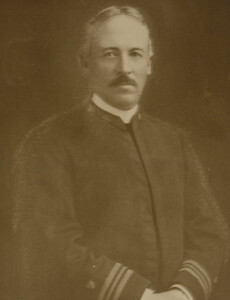 | 1905 | handwritten on verso: O.C. Hamlet, 1905- U.S. Revenue Cutter service. | Formal studio portrait of the man in uniform. This print was collected by Robert L. Myers to perpetuate memory of the "Bear." | MS0145/01-01.08#PP0387 | |||||
| 3 | No image URL. | Plates. | LB61489 | |||||||
| 4 | No image URL. | plates. | LB67673 | |||||||
| 5 | 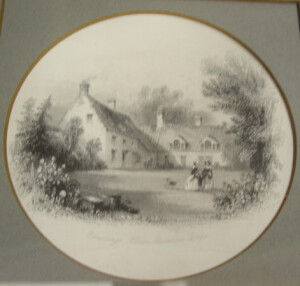 | LABEL COPY: Parsonage House, Burnham Thorpe Engraving, 19th century Gift of Mr. James E. Jewell 85.46.44 Born the son of a Norfolk clergyman, Nelson grew up in the village of Burnham Thorpe. LABEL COPY: Burnham Thorpe Parsonage, 1798 H. Edridge, artist W. Evans, engraver Gift of Mr. James E. Jewell 1985.46.44 Nelson spent his first twelve years at Burnham Thorpe, a small hamlet in Norfolk, where his father was rector of the local church. (Nelson 6/26/98) | CL22157 | |||||||
| 6 | 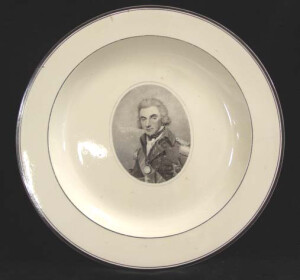 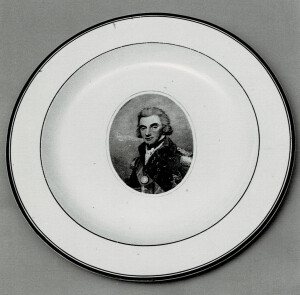 | SHORT DESCRIPTION: Cream colored oval dish with black hand painted bands around the rim and a black transfer printed portrait of Rear Admiral Horatio Nelson at the center. The portrait is an oval stipple engraving of Nelson by William Evans after Henry Edridge. Nelson is in a rear admiral's undress uniform. He is wearing the ribbon and star of a Knight of the Bath and the Cape St. Vincent gold medal on a ribbon around his neck. NOTES: Herculaneum Pottery started around 1794 by Richard Abbey and Mr. Graham near Liverpool, England. Abbey retired after a few years and Worthington, Humble, & Holland took over. "The first ware made here was blue printed, and had the name 'Herculaneum' painted in blue at the bottom of it." They began making china around 1800, then by 1833 Case, Mort, & Simpson took control of the pottery. "Of the mark used on this ware, the earliest was 'Herculaneum' in blue, then a liver stamped on, and afterwards a liver and the word 'Herculaneum.'" The company closed in 1840. See The Liverpool Mercury and Double Supplement, 11 May 1855, page 9. The portrait is a very close study of the drawing by Henry Edridge, which was much copied. It was engraved by William Evans and published in May 1798, less than a year after Nelson lost his arm at Tenerife. The portrait was most likely copied at Herculaneum by George Martin, who is listed as a 'Pottery Engraver' in the register of St Michaels-in-the-Hamlet Church in Toxteth. A plate identical to the first is discussed and illustrated in Alan Smith, "The Illustrated Guide to Liverpool Herculaneum Pottery," fig. 35. | CL6852 | |||||||
| 7 | 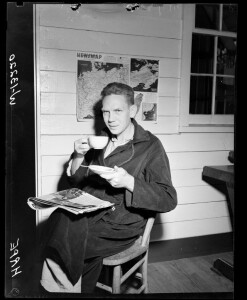 | 3/22/1945 | United States. Army–Books and reading. | Private John L. Sullivan, 13066794, of 505 West Grace Street, Richmond, Va., was among the group of wounded veterans who returned to the Camp Patrick Henry Debarkation Hospital during the last week of March from the European Theater of Operations. Sullivan was with a Signal Corp unit, following up the Allied Advance. he moved inland through as far as San Tilly, a small hamlet outside of Paris. He will remain at Camp Patrick Henry a few days, and then will be sent to a general hospital for a rest. | World War, 1939-1945–Casualties–United States.; Coffee cups–Virginia–Newport News. | Shows a man in a bath robe sitting on a chair in what looks like a porch area. He is sipping a cup of coffee and has a magazine in his lap. | P0003/01-#W-13220 | |||
| 8 | 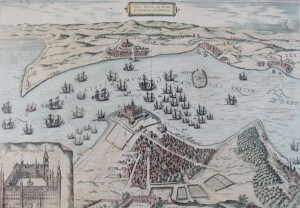 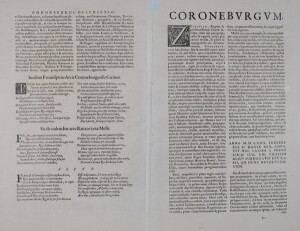 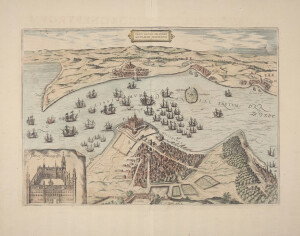 | SHORT DESCRIPTION: Engraving titled “Freti Danici or Sundt Accuratiss Delineatio” from ‘Illustriorum principumque urbium septentrionalium Europae tabulae, Theatrum praecipuarum urbium, positarum ad septentrionalem Europae plagam.’ Published in Amsterdam in 1657 by Dutch cartographer and publisher Johannes Janssonius (1588-1664). The engraving shows a birds-eye view of the Øresund (Öresund, the Sound, stretches between the Kattegat and the Baltic Sea). The city of Helsingør (Elsinor), labeled ‘Helschenor’, is in the foreground with Kronborg castle, labeled ‘Coronebvrgv,’ situated on the extreme northeastern tip of the island of Zealand at the narrowest point of the Sound. Smoke at the left side of the castle seems to indicate the castle is firing a salute. Below Helsingør fenced planted fields can be are seen as well as a fenced L-shaped building labeled ‘Lundehoue’ sitting at the bottom center. To the right of the town a point of land with a large church is labeled ‘Groseeck’ and below it to the right and against the shoreline is a town with large church labeled ‘Hafniæ pars’ (indicating Copenhagen). In the lower left corner is an inset view of Kronberg castle labeled ‘Interior Arcis magnificentia’ [magnificent interior of the fort]. Above Helsingør is the Sound full of sailing ships, many are shown anchored. Two, firing multiple cannon shots are probably saluting Kronberg castle. The Sound is labeled ‘Nobilissimvm Daniae Fretvm’ and ‘Orr Sundt.’ Near the center is an island labeled ‘Hvena’ (now called Ven). The large fenced building at the center of the island labeled ‘Uraniburgum’ is Uraniborg, also called the Castle of the Heavens. Uraniborg was the astronomical observatory built by Tycho Brahe in 1576. Beyond the Sound on the opposite shoreline, starting at the left, sitting on a point of land at the entrance to the sound, is Kullen lighthouse (established in 1561), labeled ‘Pharus’. Moving towards the center is the town of Helsingborg, labeled ‘Helsebvrgvm.’ The largest structure in the town is the medieval tower Kärnan within a circular wall. Kärnan was a large fortress that along with Kronberg castle on the opposite shore in Helsingør controlled the entrance to the Sound from the Kattegat. Moving to the right is the town of Landskrona, labeled ’Landeskron,’ and the town of Malmö, labeled ‘Elbogen.’ To the left of the town sits Malmö Castle. St. Peter’s Church can be seen within the town. NOTES: This image was republished in many different atlases. It was identified as coming from ‘Illustriorum principumque urbium septentrionalium Europae tabulae’ by the format of the Latin text on the reverse. “Illustriorum principumque urbium septentrionalium Europae tabulae” is volume three of the eight volume large town-atlas of Jan Janssonius that was published in 1657. It features 53 plans and views of Great Britain and Ireland, Denmark, Norway, Sweden, Poland and Russia. In 1653 Jansson acquired the nearly 500 plates of the Civitates Orbis Terrarum from Abraham Hogenberg, of which 232 were adapted and incorporated into the town books. NOTES: Georg Braun provides the following commentary for this image in his ‘Civitates Orbis Terrarum’: "At this place the islands of Zealand and Scania, with foothills rising on both sides, lie so close to each other that there is scarcely one mile between them. Through this strait, called Oresund, many rivers from Germany, Livonia, Sweden and Russia, which have entered the Baltic Sea, rush past due to a difference in altitude into the great sea between Jutland, Denmark and Norway. All ships that pass through the sound have to stop at this place in order to pay their respects to the castle as the royal residence by lowering their sails and to pay customs dues on their cargo to the royal treasurer." The publication ‘Cities of the World’ by Stephan Füssel, Rem Koolhaas describes the image thusly: This bird's-eye view from the west demonstratively presents the sound as a Danish inland sea, in order to counter the Swedish claims to it. The cities of Helsingborg, Landskrona and Malmö, which were Danish at the time, and the Island of Ven can clearly be seen. In the foreground is the city of Helsingor with its late Gothic cathedral of St Olai, completed in the 15th century. In the sound a sea battle is taking place, and Kronborg castle is under attack [JWE: I don’t believe this is the case. I think two ships and the castle are firing salutes at each other]. This was a strategically important fortress, where the Sound Toll was collected from passing non-Danish ships. Kronborg castle entered world literature around 1600 as the scene of Shakespeare's play Hamlet, Prince of Denmark. | CL15313 |
Created 2026 by Don Barker, CBMM volunteer, for the Chesapeake Shipbuilding Project. shipbuilding@sailingworkboats.es